Notes on Intimate Relationships
Preface
Notes from reading Roland Miller’s Intimate Relationships.
Human relationships are shaped by a wide range of influences — from prevailing cultural trends to fundamental attributes of the human species. Beyond these general factors, many individual-specific influences like personality and experience (some learned, some inherited) play a role. Ultimately, two people from the same planet but differing in many ways begin their interaction. The outcome may be frustrating or deeply satisfying.
Intimate Relationships
Human relationships come in many forms. We have parents above us and possibly children below, plus friends and lovers. This book focuses primarily on the latter two types of partnerships, specifically between adults.
Defining Intimate Relationships
Intimacy is a complex concept encompassing various components that resist easy definition. Fortunately, both researchers and laypeople agree that intimate relationships differ from casual acquaintances across six dimensions of degree:
- Knowledge: broad and private understanding
- Care: mutual caring
- Interdependence: the frequency, intensity, diversity, and duration of mutual need and influence
- Mutuality: the degree of overlap in self-acceptance of the other
- Trust: believing the other will treat you well and with respect
- Commitment: wanting the relationship to endure, investing time, effort, and resources
The Need to Belong
Why do people need intimate relationships?
The importance of intimate relationships primarily manifests as the need to belong — an evolutionary product that has become a universal human tendency, making us feel that normal social interaction with connected others is essential. It is a need for sustained affection and acceptance.
Cultural Influence
Cultural standards are the foundation upon which people build relationships, shaping expectations and defining “normal” relationship patterns.
Take the increasingly common phenomenon of cohabitation. Many high schoolers today consider premarital cohabitation a “good idea” because they can test whether they truly “get along” (Bachman et al., 2001). This attitude makes cohabitation seem quite reasonable.
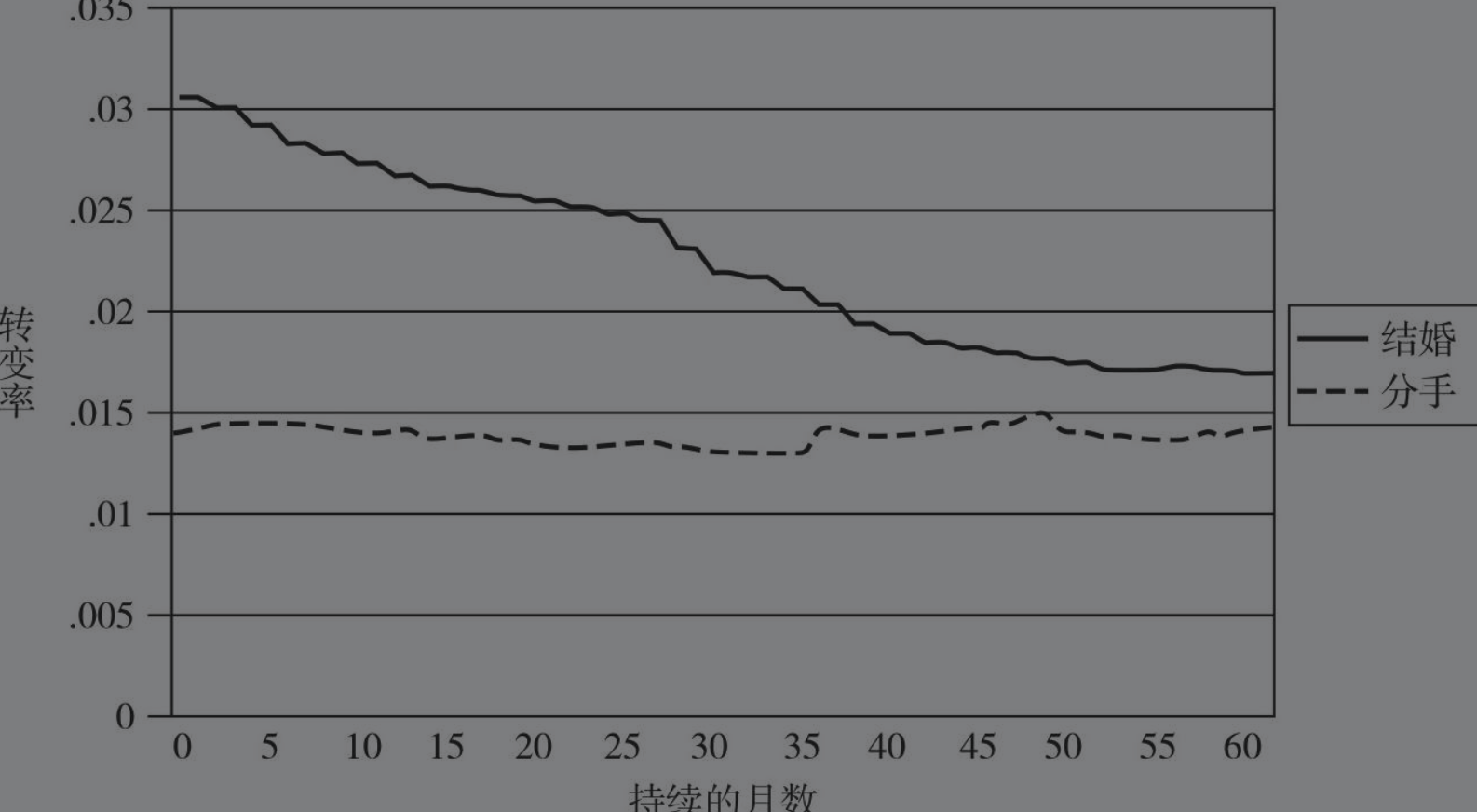
However, without concrete marriage plans, cohabitation doesn’t guarantee subsequent marital happiness — in fact, it increases divorce risk. As the research above shows, over time, cohabiting couples’ likelihood of marriage gradually decreases while their breakup probability doesn’t decline.
In summary, casual cohabitation — originally intended to test whether partners can live together harmoniously — seems to undermine positive attitudes toward marriage and the commitment to sustain it, which are the pillars of a happy marriage (Rhoades et al., 2009).
The Influence of Personal Experience
Attachment types are not genetically determined but are shaped by the interplay of innate individual characteristics and quality of caregiving.
- Secure: comfortable with intimacy and interdependence; optimistic, sociable
- Preoccupied: anxious and vigilant about any threat to intimacy; jealous, possessive
- Fearful: self-reliant, dismissive of intimacy; cold, independent
- Dismissive: afraid of abandonment; distrustful, suspicious, shy
Our childhood beliefs about the value of interpersonal relationships and whether others can be trusted originate from our interactions with caregivers. Through luck good or bad, we set off down a path toward either trusting or fearful intimate relationships. This journey never ends — the obstacles or assistance provided by subsequent companions can change the direction and course of our intimate relationships. Depending on interpersonal experiences, learned attachment styles may change over time or remain permanently stable.
The Influence of Individual Differences
Gender Differences
Differences between gender groups do exist but fall far short of the differences between individuals within the same gender.
Within-gender behavioral and attitudinal variation is typically far greater than the average between-gender difference. Men are more accepting of casual, brief sexual relationships than women (Peterson & Hyde, 2010), but this doesn’t mean all men prefer casual sex.
Some men enjoy sex with strangers while others absolutely don’t — these two groups of men are far less similar in their sexual behavior than the male and female averages. In other words, despite gender differences in sexual permissiveness, a highly permissive man differs more from a sexually conservative man than he does from the female average.
The book includes an amusing joke about stereotypes:
How to attract a woman:
Compliment her, cuddle her, kiss her, caress her, love her, comfort her, protect her, hug her, spend a fortune to make her laugh, wine and dine her, listen to her complain when she’s upset, care for her when she’s slightly ill, always be with her, always agree with her, and follow her to the ends of the earth.
How to attract a man:
Show up naked. Bring beer.
In reality, gender differences in relationship expectations are minimal — men and women are fundamentally not “opposite” types of people (Hyde, 2007). Believing the genders are vastly different makes one less likely to work at repairing cross-gender intimate relationships when conflict arises (which is inevitable). Thinking the opposite sex comes from another planet isn’t just wrong — it’s harmful. It blocks understanding of a partner’s perspective and interferes with collaborative problem-solving.
Gender Identity Differences
Gender identity differences refer to social and psychological differences between the sexes caused by culture and education — also called social gender (Wood & Eagly, 2009).
The best example of gender identity is gender roles — the “normal” behavioral patterns that society expects of men and women. Below is a common gender role classification; society expects and encourages men to be instrumental and women to be expressive:
- Instrumental: assertive, independent, ambitious, leadership-oriented, decisive — ~25%
- Expressive: warm, gentle, compassionate, kind, sensitive — ~25%
- Cross-typed: ~35%
- Undifferentiated: ~15%
Personality
The Big Five personality traits effectively distinguish people across many dimensions including behavior, thought, and emotion (McCrae & Costa, 2010):
- Openness: imaginative, unconventional, artistic — versus rigid, inflexible, dogmatic
- Extraversion: cheerful, sociable, enthusiastic — versus cautious, reserved, shy
- Conscientiousness: hardworking, reliable, orderly — versus unreliable, careless
- Agreeableness: sympathetic, cooperative, trusting — versus irritable, temperamental, hostile
- Neuroticism: the degree of moodiness, worry, anxiety, and anger
Listed from least to most important. The most significant of the Big Five is the one with negative effects: neuroticism (Malouff et al., 2010). Neurotic individuals are prone to anger and anxiety — tendencies that often cause interpersonal friction, pessimism, and arguments (Suls & Martin, 2005).
Self-Esteem
Self-esteem is essentially self-evaluation within interpersonal contexts — a kind of “social relationship barometer.” When others treat us positively and value their relationship with us, self-esteem is high; when we can’t attract others’ attention, it’s low.
We humans are highly social animals. If others don’t like us, liking ourselves becomes very difficult (indeed, it would be quite unrealistic). In most cases, people who chronically receive insufficient acceptance and appreciation develop negative self-evaluations through sustained low self-esteem.
Notably, regarding self-esteem’s impact on intimate relationships: low self-esteem individuals sometimes underestimate their partner’s love, thereby damaging the relationship (Murray et al., 2001).
We all need balance between connection with others and self-protection, but low self-esteem people consistently prioritize their fragile egos over intimate relationships. Their self-doubt and hypersensitivity manufacture mountains of problems from countless trivial matters. They mistakenly interpret the normal bumps of love as ominous signs of their partner’s rejection. Then they display off-putting, self-defeating hurt and anger, completely severing the very comfort from their partner that they crave. By contrast, those with high self-esteem don’t bat an eye at the same minor hiccups, confidently expecting their partner’s acceptance and positive regard.
The Influence of Human Nature
The environmental pressures humans faced for survival over thousands of years have left mental and emotional traces. Certain inherited emotional and behavioral responses originated from our distant ancestors and are no longer necessary in modern times, yet these survival vestiges are indelibly carved into our character, giving everyone certain predispositions.
Three assumptions of evolutionary psychology:
- Sexual selection has made humans the species we are today.
- The sexes differ only because, to some degree, they faced different reproductive challenges in the past (parental investment).
- Culture determines whether evolved behavioral patterns remain adaptive, and culture changes far faster than evolution (paternity uncertainty).
The Influence of Interpersonal Interaction
Relationships are often greater than the sum of their parts — this is the effect of the final component of relationships: “interaction.”
Take trust in a romantic relationship as an example. Trust is a bidirectional process, simultaneously influenced by both your and your partner’s temperaments. It arises from the dynamic process of giving and receiving with your partner every day. In other words, trust is a flowing process rather than a static thing — it rises and falls across all your relationships.
The Dark Side of Relationships
We must acknowledge that relationships also carry potential costs — sometimes dealing with others brings misfortune and pain.
When people get close to others, they may fear their most cherished secrets being exposed or exploited. They may worry about the loss of autonomy and self-control that comes with interdependence (Baxter, 2004). They might fear being abandoned by those they depend on. They recognize that deception can exist in relationships, and people sometimes confuse sex with love (Firestone & Catlett, 1999). In fact, most people (56%) have experienced relationship difficulties in the past 5 years (Levitt et al., 1996).
So why take the risk? The book’s answer is quite romantic:
Because we are social animals. We need each other. Without intimate connections to others, we would wither and die.